


Working principle of equipment for slaked lime production equipment
As a core raw material in the fields of building materials,environmental protection,and chemical engineering,the production process of hydrated lime requires the coordination of multiple equipment links.From the crushing of limestone to the digestion of quicklime,and then to the grinding and transportation of hydrated lime,each step relies on the control of specific equipment.
1、Raw material pretreatment
The starting point for the production of hydrated lime is the pretreatment of limestone(CaCO3).Limestone needs to be first roughly crushed by a jaw crusher to crush large raw materials to a particle size of 50-100mm,and then finely crushed by an impact crusher or cone crusher to obtain particles with a particle size less than 20mm.This process achieves particle size control by adjusting the width and speed of the crusher discharge port.
The screening process is achieved through particle size classification using a vibrating screen.The vibrating screen of the hydrated lime production equipment uses high-frequency vibration to slaked lime production equipment on the screen.Fine particles enter the next process through the screen holes,while coarse particles return to the crusher for reprocessing.For example,a production line uses a three-layer vibrating screen that can simultaneously separate materials of three different particle sizes,ensuring that the uniformity of limestone particle size entering the digestion process reaches over 95%,providing stable conditions for subsequent reactions.
1.Lime kiln calcination:decomposition of calcium carbonate
Calcination is the core chemical process in the production of hydrated lime,which needs to be completed in a lime kiln.Lime kilns are divided into two mainstream types:rotary kilns and vertical kilns:
Rotary kiln:By rotating the kiln body,limestone is fully in contact with the hot gas flow,achieving uniform calcination.Its working principle is:limestone enters from the kiln tail,absorbs waste heat from flue gas in the preheating zone to 850℃,and then enters the calcination zone(1200-1300℃),where calcium carbonate decomposes into calcium oxide(quicklime)and carbon dioxide.For example,a certain rotary kiln adopts oxygen rich combustion technology,which increases the stability of calcination temperature by 15℃and the activity degree(T60)of quicklime reaches over 380ml.
Vertical kiln:Effective calcination is achieved through countercurrent heat transfer.Limestone is added from the top of the kiln and passes through the preheating zone,calcination zone,and cooling zone from top to bottom.In the calcination zone,the combustion of coke or natural gas provides heat to decompose calcium carbonate.A certain vertical kiln has optimized the design of the material distributor to reduce the radial temperature deviation of the kiln to±10℃,and the over burning rate of quicklime has been reduced to below 3%.
2.Lime digester:hydration reaction of calcium oxide
The calcined quicklime needs to react with water in a digester to produce mature lime.The digestion process is divided into three steps:
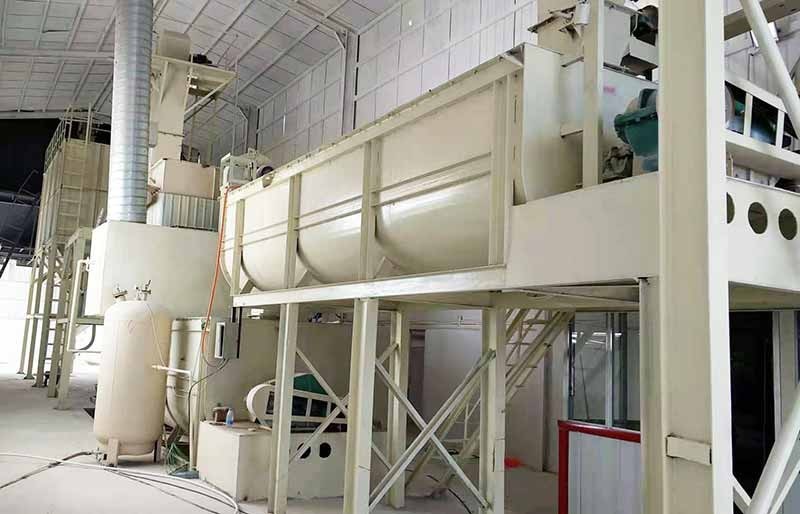
Mixing:Lime and water are initially mixed in a mixing device to form moist particles.For example,a certain dry digester uses a spiral stirrer to control the water cement ratio by adjusting the speed,ensuring uniform distribution of water in the early stage of the reaction.
Reaction:Stir continuously at a high temperature of 80-100℃,and calcium oxide reacts fully with water,releasing a large amount of heat(about 1150kJ/kg).A spray type digester atomizes water to 50-100μm particle size through a high-pressure nozzle,reducing the reaction time to 3 minutes,and improving the digestibility to 98%.
Aging:Particles that have not fully reacted enter the aging zone,and the reaction is ensured by extending the residence time(usually 1-2 hours).A certain enterprise adopts a three-stage digester to control the free water content of hydrated lime below 1%,with an activity level of 420ml,which is significantly better than the wet process.
3、Grinding and Grading:Process of Particle Size Control
The digested hydrated lime needs to be further refined by a grinding machine to meet the needs of different fields.Raymond mill is a mainstream equipment,and its working principle is:
Crushing stage:Hydrated lime falls from the feed inlet between the grinding roller and the grinding ring,and is crushed under centrifugal force.
Grinding stage:The grinding roller rotates around the main shaft to perform high-pressure grinding on the material,while hot air enters from the air inlet to dry the material.
4、Transportation and Packaging:Integrated Application of Automation Systems
The transportation and packaging of hydrated lime need to be completed through pneumatic conveying system and packaging machine:
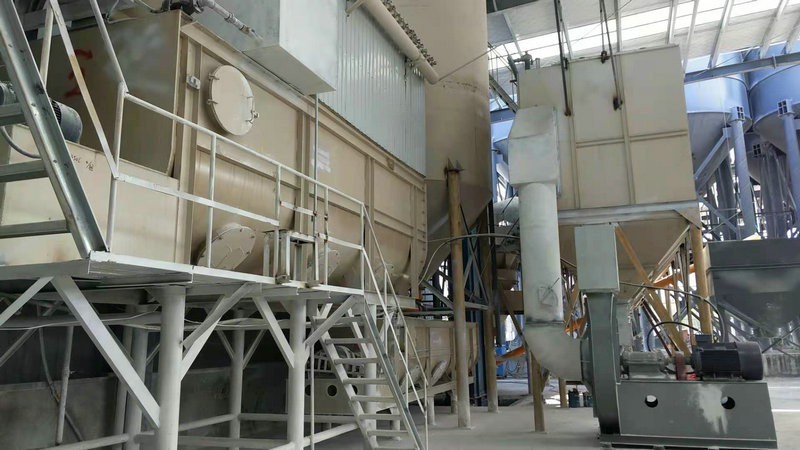
Pneumatic conveying:using compressed air to transport hydrated lime powder to storage bins or packaging machines.A certain enterprise adopts a negative pressure dense phase pneumatic conveying system,which achieves low energy consumption and low damage conveying by slaked lime production equipment velocity(15-25m/s)and solid gas ratio,with a conveying efficiency of over 98%.
Packaging machine:Adopting a fully automatic valve pocket packaging machine,measured by an electronic scale,the weight of each bag of hydrated lime is controlled at 25kg or 50kg.A certain packaging machine is equipped with a dust removal device,which can recover 99%of the dust and ensure that the workshop environment meets the standards.
Currently,the production equipment of hydrated lime is developing towards intelligence and green direction:
Intelligent control:By integrating temperature,pressure,flow and other sensors through a PLC system,real-time monitoring and automatic adjustment of process parameters can be achieved.For example,a certain enterprise adopts digital twin technology to construct a virtual kiln model,optimizes combustion parameters through AI algorithms,and reduces energy consumption per ton of ash by 15%.
Green transformation:The production equipment of hydrated lime adopts a waste heat recovery device to use the heat released from digestion reaction to preheat raw materials or dry finished products.A certain enterprise reduces steam consumption by 30%through a heat recovery system;Meanwhile,equipped with desulfurization and denitrification devices,the emission concentrations of SO₂and NOx in the exhaust gas are kept below 50mg/m³and 100mg/m³,respectively.
The working principle of the equipment for slaked lime production equipment is a collaborative process of physical crushing,chemical conversion,and control.From the crushing of limestone to the packaging of hydrated lime,each step is effectively and stably operated through specific equipment.With the breakthrough of intelligent and green technologies,the production equipment of hydrated lime is upgrading from"functional realization"to"intelligent optimization",providing core support for the sustainable development of industries such as building materials and environmental protection.


