


Guide to Types of Raymond Grinding Mill
Raymond grinding mill is a widely used ultra-fine grinding equipment in mining,building materials,chemical industry,metallurgy and other industries.With the advantages of stable operation,uniform powder fineness,low investment cost and convenient maintenance,it has long occupied a mainstream position in the powder processing market.As the diversity of raw materials and increasingly strict requirements for finished powder fineness in the industry,various upgraded models and specifications of Raymond grinding mill have been developed.Many users are confused about the differences,applicable materials and production capacity ranges of different models during equipment selection,which easily leads to improper model matching,mismatched output capacity and unqualified grinding fineness.This article provides a detailed guide to Raymond grinding mill types,elaborating on model series,structural differences,production capacity,fineness and applicable working conditions for selection reference.
The traditional classic Raymond grinding mill is the earliest and most widely used basic model,also known as the ordinary suspended roller Raymond mill.It is mainly composed of main unit,fan,analyzer,pipeline and powder collector.Materials are ground through extrusion between grinding rollers and grinding rings.Featuring mature and simple structure,universal spare parts and easy maintenance,it is suitable for processing medium-hard non-metallic minerals such as limestone,calcite,talc,dolomite,gypsum and kaolin.The finished fineness is adjustable from 80 to 325 mesh.With low investment threshold and low failure rate,it is ideal for small and medium-sized powder processing plants.Nevertheless,it has limited maximum output capacity,fast wear when processing hard materials and narrow room for fineness improvement.
High-pressure suspended roller Raymond grinding mill is an upgraded version based on the ordinary model.Its core improvement is the installed high-pressure spring device,which greatly enhances the extrusion force of grinding rollers on materials.With the same feeding size,it achieves stronger grinding performance,and can process not only soft minerals but also relatively hard materials including iron ore,manganese ore and barite.Its adjustable fineness range is wider,reaching up to about 500 mesh,and the single-machine output is 20%~30%higher than ordinary models.Equipped with a high-pressure fan,it improves pipeline conveying efficiency and sufficient cyclic grinding of materials,effectively avoiding machine blocking.It is extensively adopted by medium-sized powder processing plants for its excellent cost performance balancing fineness and output.
The enhanced ultra-fine Raymond grinding mill is specially designed for fine powder processing.Through optimized internal analyzer rotating speed,air circulation system and sealing structure,its maximum grinding fineness can reach 1200 mesh with uniform particle size and few coarse particles.Excellent body sealing reduces dust leakage and meets environmental protection requirements.It is applicable to high-value fine processing industries such as kaolin,bentonite,carbon black and chemical raw materials.Upgraded wear-resistant internal parts also reduce consumption during long-time fine grinding.
In addition,there are special models including energy-saving improved Raymond mill,explosion-proof Raymond grinding mill and integrated dust-removal Raymond mill.The explosion-proof model is specially designed for flammable and explosive powder with explosion-proof treatment on motors,circuits and seals.The integrated dust-removal model is equipped with bag dust collector to meet environmental emission standards.The energy-saving model optimizes air circuit and motor configuration to reduce power consumption for long-term continuous operation.
Choose ordinary Raymond grinding mill for common minerals with limited budget and medium-small output;select high-pressure suspended roller Raymond mill for hard materials pursuing higher fineness and output;adopt super-pressure trapezoidal mill for large-scale mass deep processing;choose ultra-fine Raymond mill for high-mesh fine powder processing;select special explosion-proof and dust-removal models for flammable,explosive and high environmental protection conditions.Reasonable selection according to material hardness,feeding size,finished mesh and hourly output can maximize equipment performance,reduce later operation and maintenance costs,and improve production benefits of powder processing.
The traditional classic Raymond grinding mill is the earliest and most widely used basic model,also known as the ordinary suspended roller Raymond mill.It is mainly composed of main unit,fan,analyzer,pipeline and powder collector.Materials are ground through extrusion between grinding rollers and grinding rings.Featuring mature and simple structure,universal spare parts and easy maintenance,it is suitable for processing medium-hard non-metallic minerals such as limestone,calcite,talc,dolomite,gypsum and kaolin.The finished fineness is adjustable from 80 to 325 mesh.With low investment threshold and low failure rate,it is ideal for small and medium-sized powder processing plants.Nevertheless,it has limited maximum output capacity,fast wear when processing hard materials and narrow room for fineness improvement.
High-pressure suspended roller Raymond grinding mill is an upgraded version based on the ordinary model.Its core improvement is the installed high-pressure spring device,which greatly enhances the extrusion force of grinding rollers on materials.With the same feeding size,it achieves stronger grinding performance,and can process not only soft minerals but also relatively hard materials including iron ore,manganese ore and barite.Its adjustable fineness range is wider,reaching up to about 500 mesh,and the single-machine output is 20%~30%higher than ordinary models.Equipped with a high-pressure fan,it improves pipeline conveying efficiency and sufficient cyclic grinding of materials,effectively avoiding machine blocking.It is extensively adopted by medium-sized powder processing plants for its excellent cost performance balancing fineness and output.
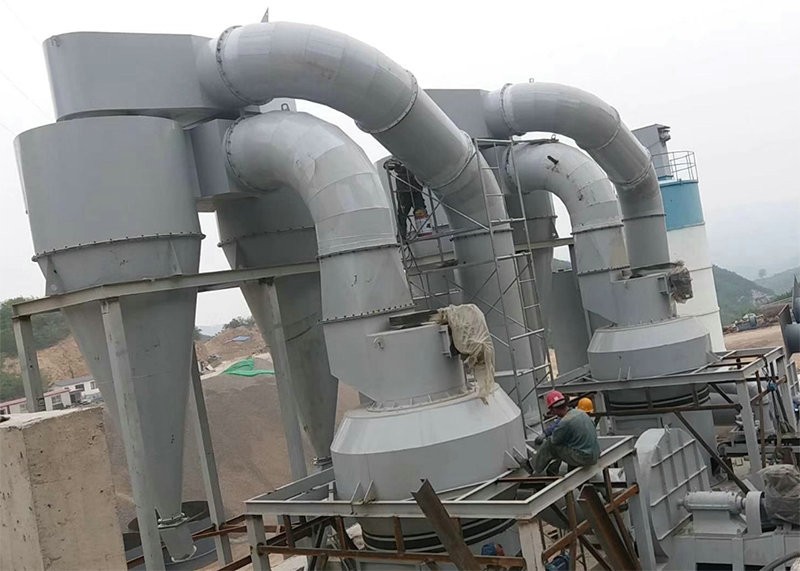
The enhanced ultra-fine Raymond grinding mill is specially designed for fine powder processing.Through optimized internal analyzer rotating speed,air circulation system and sealing structure,its maximum grinding fineness can reach 1200 mesh with uniform particle size and few coarse particles.Excellent body sealing reduces dust leakage and meets environmental protection requirements.It is applicable to high-value fine processing industries such as kaolin,bentonite,carbon black and chemical raw materials.Upgraded wear-resistant internal parts also reduce consumption during long-time fine grinding.
In addition,there are special models including energy-saving improved Raymond mill,explosion-proof Raymond grinding mill and integrated dust-removal Raymond mill.The explosion-proof model is specially designed for flammable and explosive powder with explosion-proof treatment on motors,circuits and seals.The integrated dust-removal model is equipped with bag dust collector to meet environmental emission standards.The energy-saving model optimizes air circuit and motor configuration to reduce power consumption for long-term continuous operation.
Choose ordinary Raymond grinding mill for common minerals with limited budget and medium-small output;select high-pressure suspended roller Raymond mill for hard materials pursuing higher fineness and output;adopt super-pressure trapezoidal mill for large-scale mass deep processing;choose ultra-fine Raymond mill for high-mesh fine powder processing;select special explosion-proof and dust-removal models for flammable,explosive and high environmental protection conditions.Reasonable selection according to material hardness,feeding size,finished mesh and hourly output can maximize equipment performance,reduce later operation and maintenance costs,and improve production benefits of powder processing.


