


Do you know how a Raymond grinding mill materials?
As one of the most widely used fine powder grinding equipment in industrial production,the Raymond grinding mill is mainly used to grind various non-metallic minerals,chemical raw materials,building materials and other materials into fine powder of 80 to 400 meshes or even finer.It is suitable for the production needs of many industries such as mining,metallurgy,building materials,chemical industry and environmental protection.Its grinding process is not a simple single crushing,but a continuous and automatic closed-loop process composed of"pretreatment—core rolling—wind classification—finished product collection—air circuit circulation".Relying on the coordinated operation of core components,it achieves efficient and uniform grinding of materials.Below,combined with its structural principle,we will detail each step of the grinding process,so that everyone can clearly understand how the Raymond grinding mill gradually grinds bulk materials into qualified fine powder.
I.Preparation Before Grinding:Material Pretreatment and Equipment Debugging
The grinding efficiency and finished product quality of the Raymond grinding mill are inseparable from the preliminary material pretreatment and equipment debugging,which is the basis for ensuring the smooth and stable subsequent grinding process and a key link easily overlooked by many users.
First of all,material pretreatment.The feeding port size of the Raymond grinding mill is limited,and the internal space of the grinding chamber and the rolling range of the grinding rollers and grinding ring are fixed.Therefore,bulk materials cannot directly enter the grinding chamber and must be pretreated first:the original bulk materials(such as limestone,calcite,dolomite,talc,etc.)are crushed into small pieces with a particle size≤30mm by coarse crushing equipment such as jaw crushers and hammer crushers,so as to avoid bulk materials blocking the feeding port,damaging the grinding rollers and grinding ring,and at the same time reduce the grinding load and improve the grinding efficiency.The pretreated small materials will be transported to the silo by a bucket elevator,and then uniformly,continuously and quantitatively fed into the main grinding chamber of the Raymond grinding mill by a vibrating feeder to ensure stable feeding volume,avoiding blockage of the grinding chamber due to excessive feeding,or idling of the equipment and waste of energy due to insufficient feeding.
Secondly,equipment debugging.Before starting the grinding operation,it is necessary to comprehensively inspect and debug the core components of the Raymond grinding mill:check whether the gap between the grinding rollers and the grinding ring is reasonable(too large a gap will lead to insufficient grinding,and too small a gap will easily cause excessive wear);check the wear condition of the scraper to ensure that the scraper can normally scoop up materials and feed them into the gap between the grinding rollers and the grinding ring;check whether the blade speed of the classifier meets the preset requirements for the fineness of the finished product;check the airtightness of the fan,cyclone collector and bag filter to ensure that the air circuit is closed,so as to avoid dust overflow and air leakage,which will affect the classification and collection effect.After debugging,start the equipment and conduct no-load test operation first.After confirming that all components are running normally without abnormal noise and vibration,start feeding and grinding.
II.Analysis of Core Structure:Coordinated Operation of Various Components to Ensure Grinding Effect
The grinding process of the Raymond grinding mill relies on the precise cooperation of various core components,each of which has its unique role and is indispensable.The core structure of its main machine mainly includes the following parts.Clarifying the function of each component can better understand the grinding principle:
1.Grinding Roller:As the core grinding component,there are usually 3-5 grinding rollers,which are evenly hung on the plum blossom frame and can revolve at high speed with the main shaft and rotate at the same time.The grinding roller is made of high-strength wear-resistant material,and its surface is specially treated,which can bear high-intensity extrusion and friction and prolong the service life.Its main function is to press tightly on the grinding ring through centrifugal force to crush materials by rolling and pressing.
2.Grinding Ring:Fixed on the inner wall of the main machine of the Raymond grinding mill,it has an annular structure corresponding to the grinding roller.It is also made of wear-resistant material and is the main contact surface for material grinding.The inner wall of the grinding ring is smooth and flat,ensuring that a uniform rolling gap can be formed between the grinding roller and the grinding ring,so that the material is subjected to uniform grinding force and the uniformity of the finished powder is guaranteed.
3.Scraper:Installed under the plum blossom frame of the main shaft,it rotates at high speed with the main shaft.The shape of the scraper is specially designed,which can efficiently scoop up the small materials fed from the feeding port and throw them into the gap between the grinding roller and the grinding ring,ensuring that the materials can be ground in time and avoiding material accumulation at the bottom of the grinding chamber,which will affect the grinding efficiency.
4.Classifier:Installed on the upper part of the main machine,it is a classification component with a high-speed rotating blade rotor inside.Its core function is to control the fineness of the finished powder.By adjusting the blade speed,it separates qualified fine powder from coarse powder to achieve dynamic classification and ensure that the fineness of the finished product meets the production requirements.
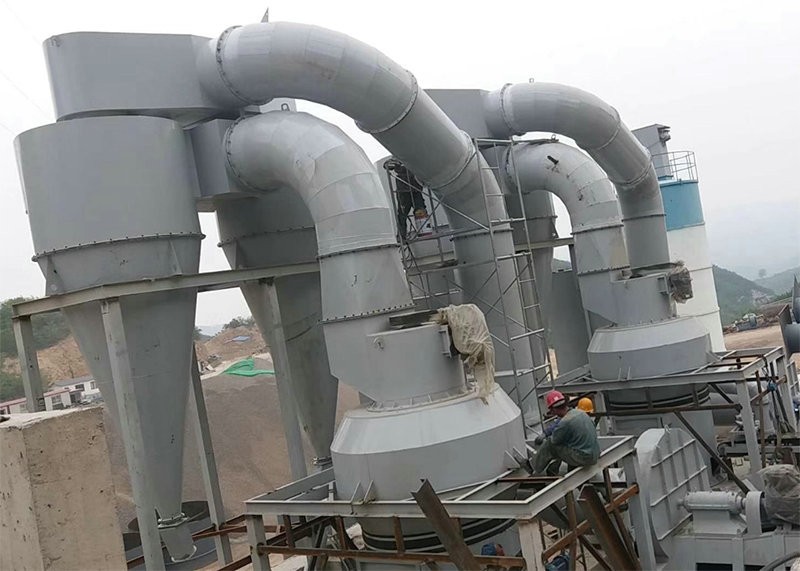
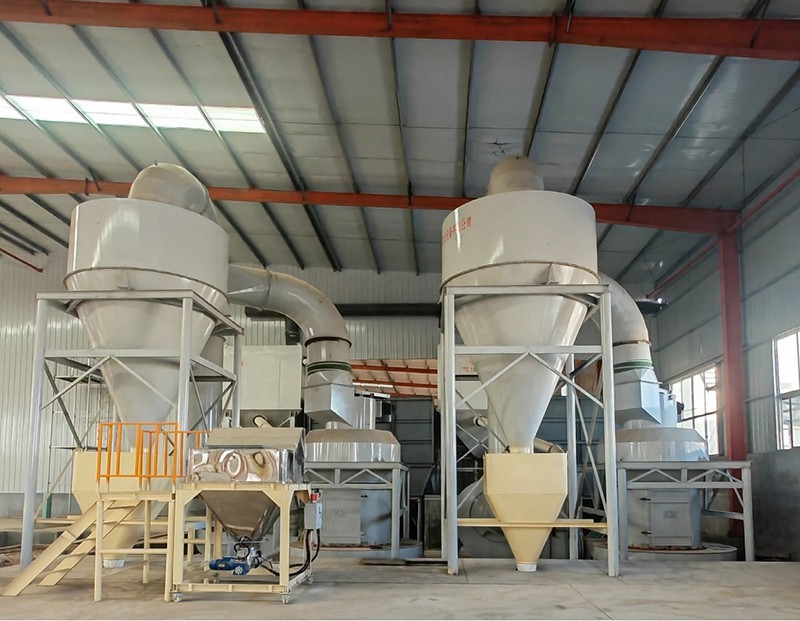
5.Fan,Cyclone Collector and Bag Filter:These three components form the air circuit system of the Raymond grinding mill.The fan provides negative pressure air flow,which is the power source for material transportation and classification;the cyclone collector is used to collect qualified fine powder finished products;the bag filter is used to recover the trace dust remaining in the air flow and purify the tail gas,which not only avoids dust pollution to the environment,but also improves the material utilization rate.
 III.Detailed Grinding Process:Complete Process from Bulk Materials to Qualified Fine Powder
After the material pretreatment and equipment debugging are completed,the Raymond grinding mill enters the formal grinding stage.The whole process is continuous and does not require too much manual intervention.It can be specifically divided into four core steps,each of which is interlocking to ensure the grinding efficiency and finished product quality:
Step 1:Feeding and Conveying,Accurately Sending into the Grinding Chamber
The pretreated small materials(particle size≤30mm)are uniformly and quantitatively fed into the main grinding chamber of the Raymond grinding mill by a vibrating feeder.The feeding speed of the vibrating feeder can be adjusted according to the grinding efficiency and finished product requirements to ensure that the feeding volume matches the grinding capacity,avoiding blockage of the grinding chamber due to excessive feeding,or idling of the equipment and increased energy consumption due to insufficient feeding.After entering the grinding chamber,the materials will naturally fall to the bottom of the grinding chamber,waiting to be scooped up by the scraper and enter the next rolling and grinding link.
Step 2:Centrifugal Rolling,Core Crushing Link
This is the core step of the Raymond grinding mill grinding materials and the key to grinding materials into fine powder.When the main machine of the Raymond grinding mill is started,the main shaft drives the plum blossom frame,grinding rollers and scraper to rotate at high speed,with a rotation speed of hundreds of revolutions per minute.Under the action of centrifugal force generated by high-speed rotation,the grinding rollers hung on the plum blossom frame will be thrown outward quickly and pressed tightly on the inner wall of the fixed grinding ring to form a uniform rolling gap.At this time,the scraper rotating with the main shaft will continuously scoop up the materials at the bottom of the grinding chamber and throw them into the gap between the grinding roller and the grinding ring at an appropriate angle.
After entering the gap,the materials will be subjected to the combined action of extrusion,rolling friction and shear force from the grinding rollers—the revolution and rotation of the grinding rollers will continuously roll and grind the materials,gradually crushing and grinding the bulk materials into small powder.In this process,the wear resistance of the grinding rollers and grinding ring directly affects the grinding efficiency and service life of the components.Therefore,they are usually made of high-strength and high-wear-resistant alloy materials.At the same time,the wear condition is regularly checked and replaced in time to avoid the decline of grinding effect due to component wear.
Step 3:Wind Conveying and Dynamic Classification,Screening Qualified Fine Powder
After the materials are ground into powder,they will not be discharged directly,but need to be conveyed and classified by wind to screen out fine powder that meets the required fineness,and the coarse powder will be returned to the grinding chamber for re-grinding.This is also one of the core advantages of the Raymond grinding mill's efficient and uniform grinding.
The fan of the Raymond grinding mill blows continuous circulating air flow upward from the bottom of the main machine.The air flow forms a negative pressure environment in the grinding chamber,blowing up the ground powder and conveying it upward to the classifier on the upper part of the main machine.When the powder air flow enters the classifier,it will encounter a high-speed rotating blade rotor.At this time,the powder will be subjected to two forces:one is the lifting force of the air flow,and the other is the centrifugal force generated by the rotation of the blades.According to the size of the powder particle size,the balance relationship between these two forces will be different:
For the coarse powder with larger particle size,its mass is larger,and the centrifugal force it receives is greater than the lifting force of the air flow.It will be thrown back to the bottom of the grinding chamber by the blade rotor,scooped up by the scraper again,and re-ground between the grinding roller and the grinding ring until it is ground into fine powder that meets the requirements;for the qualified fine powder with particle size meeting the requirements,its mass is smaller,and the lifting force of the air flow it receives is greater than the centrifugal force.It can smoothly pass through the blade gap of the classifier and be conveyed upward with the air flow to enter the next finished product collection link.
It should be noted here that the key to controlling the fineness of the finished product lies in the blade speed of the classifier:the higher the speed,the greater the centrifugal force generated by the blade rotation,the smaller the particle size of the powder that can pass through,and the finer the finished product;on the contrary,the lower the speed,the coarser the fineness of the finished product.Users can flexibly adjust the blade speed of the classifier according to the actual production needs to realize the production of powder with different fineness,which is suitable for the use needs of different industries(for example,80-120 meshes are commonly used in the building materials industry,120-200 meshes in the chemical industry,and 300-400 meshes in the fine chemical industry).
Step 4:Finished Product Collection and Air Circuit Circulation,Realizing Continuous Production
The qualified fine powder screened by the classifier will enter the cyclone collector with the air flow.The cyclone collector uses the principle of centrifugal sedimentation.When the powder-containing air flow enters the cyclone collector,the air flow will rotate at high speed along the wall of the device.The powder is thrown to the wall under the action of centrifugal force,then falls to the hopper at the bottom of the collector along the wall,and is discharged through the discharge valve to become the final finished fine powder.
In the cyclone collector,most of the qualified fine powder will be collected,while a small amount of dust with extremely small particle size will continue to move upward with the air flow and enter the bag filter.The bag filter is equipped with multiple filter bags inside.When the air flow passes through the filter bags,the dust will be intercepted and filtered by the filter bags.The residual dust will adhere to the surface of the filter bags and be cleaned regularly by means of pulse jetting.The collected dust can be recovered as finished products to avoid material waste.The tail gas purified by the bag filter will become clean and free of dust,meet the environmental protection emission standards,and be directly discharged into the atmosphere.
It is worth noting that the air circuit system of the Raymond grinding mill adopts a closed-circuit circulation and negative pressure operation mode:the air flow blown by the fan passes through the grinding chamber,classifier,cyclone collector and bag filter,and then returns to the fan to form a closed-loop circulation.This design not only can reduce air leakage,improve the efficiency of material transportation and classification,but also can effectively prevent dust overflow,protect the production environment,and reduce energy consumption,realizing continuous and environment-friendly production.
IV.Key Notes During the Grinding Process
To ensure the smooth grinding process of the Raymond grinding mill,extend the service life of the equipment,and ensure the stable quality of the finished product,the following points should be noted during the grinding process:
1.Material Characteristic Control:The Raymond grinding mill is mainly suitable for grinding non-flammable and non-explosive non-metallic minerals with hardness below 9.3,such as limestone,calcite,talc,gypsum,etc.It is strictly prohibited to grind materials with excessively high hardness(such as metal ores),flammable and explosive materials,or materials containing impurities(such as metal硬块),so as to avoid damaging the grinding rollers and grinding ring or causing safety accidents.
2.Adjustment of Operating Parameters:According to the hardness,humidity of materials and the requirements for the fineness of finished products,reasonably adjust the feeding speed,classifier blade speed,fan air volume and grinding roller pressure.For example,when the material hardness is high,the grinding roller pressure can be appropriately increased,the feeding speed can be reduced,and the grinding time can be prolonged;when the material humidity is high,it needs to be dried in advance to avoid powder caking,which will affect classification and collection.
3.Equipment Maintenance:During the grinding process,regularly check the wear condition of the grinding rollers,grinding ring and scraper,and replace the seriously worn components in time;regularly clean the dust in the cyclone collector and bag filter to avoid blockage;regularly check the airtightness of the air circuit system and repair the leakage points in time to ensure normal negative pressure operation.
4.Abnormal Handling:If problems such as excessive equipment vibration,abnormal noise,unqualified fineness of finished products or reduced output occur during the grinding process,the machine should be shut down immediately for inspection,the cause should be identified(such as grinding roller wear,excessive feeding,air circuit blockage,etc.),and the machine should be restarted after timely handling to avoid equipment damage.
In general,the grinding process of the Raymond grinding mill is a continuous closed-loop process of"pretreatment—core rolling—wind classification—finished product collection—air circuit circulation".Its core principle is to use the centrifugal force generated by the high-speed rotation of the grinding rollers and grinding ring to extrude,roll and shear materials,grind bulk materials into fine powder,then screen out qualified fine powder through air conveying and dynamic classification by the classifier,and the coarse powder is returned for re-grinding,finally realizing efficient,uniform and continuous fine powder production.
The entire grinding process relies on the coordinated operation of various core components.Every link from material pretreatment to finished product collection affects the grinding efficiency and finished product quality.Through reasonable equipment debugging,parameter adjustment and daily maintenance,the Raymond grinding mill can operate stably,adapt to the fine powder production needs of different industries,and provide an efficient and reliable grinding solution for the production of mining,building materials,chemical industry and other industries.


