


Installation Steps of the Raymond Grinding Mill
As a core milling equipment in mining,metallurgy,chemical industry,building materials and other industries,the installation quality of the Raymond grinding mill directly determines the operational stability,milling efficiency and service life of the equipment.The installation process must follow the principles of precise positioning,standardized operation and step-by-step progress,covering foundation preparation,equipment hoisting,component assembly,commissioning and acceptance,and every detail must be strictly controlled.Based on industrial practical experience,this paper elaborates on the complete installation steps of the Raymond grinding mill,providing scientific and implementable references for on-site installation to help the equipment be put into normal operation quickly.
Adequate preparation before installation is a prerequisite for smooth installation,focusing on three core aspects:site,equipment and tools,together with proper safety protection to prevent rework or safety accidents in the later stage.
For site preparation,a flat,solid and well-ventilated site shall be selected in strict accordance with the equipment installation drawings,ensuring that the site area meets the overall layout of the equipment and later maintenance needs,with reserved space for hoisting equipment operation.Foundation construction is critical:concrete with a strength grade of no less than C30 shall be used for pouring with a thickness of no less than 1.5 meters.Anchor bolt holes shall be accurately reserved during pouring,with a position deviation controlled within±2mm to avoid affecting subsequent equipment positioning.After pouring,the foundation curing period shall be no less than 7–10 days,which shall be appropriately extended in winter,to ensure that the concrete strength reaches more than 75%before proceeding to the next step,so as to eliminate settlement,vibration and other problems during equipment operation caused by an unstable foundation.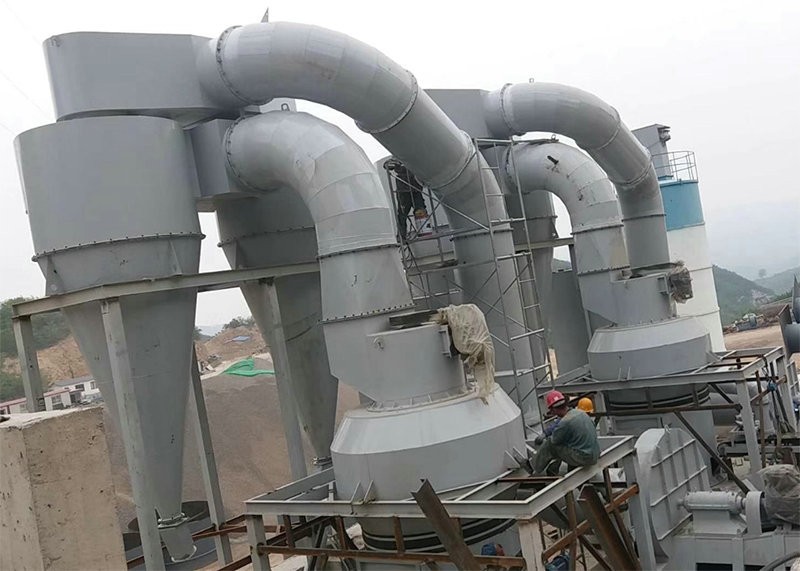
Equipment inspection shall be carried out after unpacking.Check the model and quantity of main engine,classifier,blower,jaw crusher,elevator and other components one by one,inspect whether the component surfaces are damaged or deformed,whether seals and fasteners are complete,and whether key components such as grinding rollers,grinding rings and main shafts are intact.If the time from equipment delivery to installation exceeds 6 months,clean and inspect the main engine central shaft system,transmission device and other parts,and fill sufficient lubricating oil.Meanwhile,prepare necessary installation tools,including 2–3 ton hoisting equipment,laser level meter,vibration tester,wrenches,welding machines,hydraulic jacks,etc.,as well as auxiliary fittings such as parallel iron blocks and inclined iron blocks.Parallel iron blocks shall be made of thick steel plates with a thickness of no less than 20mm to ensure good contact with the foundation.
In addition,a qualified professional installation team shall be arranged.Installers must be familiar with the equipment manual and installation drawings,receive technical training in advance to clarify the installation process and safety specifications.A full-time safety officer shall be assigned on site,the operation area shall be delimited,safety warning signs shall be set up,and safety protection measures for high-altitude operation and hoisting operation shall be in place.
The installation of the Raymond grinding mill shall follow the sequence of foundation acceptance→main engine installation→transmission device installation→auxiliary equipment installation→pipeline and electrical installation.Installation accuracy shall be controlled at each step to ensure firm connection and smooth operation of components.
Step 1:Foundation Acceptance and Anchor Bolt Installation
First,clean up debris on the foundation surface,inspect whether the foundation dimensions and reserved positions of anchor bolt holes are consistent with the drawings,and chisel the positions around the reserved holes where parallel iron blocks are placed to ensure tight fitting between the parallel iron blocks and the foundation.Place anchor bolts into the reserved holes,adjust the verticality of the bolts,then pour secondary grouting material.After the grouting material solidifies,tighten the anchor bolts to ensure no looseness,laying a foundation for subsequent equipment installation.
Step 2:Main Engine Installation
Use hoisting equipment to lift the main engine steadily to the foundation,adjust the position of the main engine to align the main engine base with the foundation.Lay rubber shock-absorbing pads at the contact between the main engine base and the cement foundation and between the anchor bolt connections to reduce vibration during equipment operation.Calibrate the plane of the main engine base with a frame level at four points along the cross crisscross line,ensuring the horizontality error is controlled within 0.1mm/m.Meanwhile,adjust the coupling between the main engine and the transmission device to ensure the coaxiality of the two half-couplings is less than 0.20mm,the non-parallelism is no more than 0.1mm,and the clearance is kept between 5–8mm,so as to avoid abnormal noise and vibration during operation.
Step 3:Transmission Device Installation
First,hoist the transmission device base into the pit and backfill it,control the installation height,and calibrate the upper plane of the base with a level meter to ensure the plane is horizontal.Install the motor and reducer on the base and fix them firmly with bolts.Adjust the positions of the motor and reducer to ensure the alignment of pulleys or couplings,with moderate belt tightness.Over-tightening may cause motor overload and belt wear,while over-loosening may lead to slipping and affect power transmission.
Step 4:Auxiliary Equipment Installation
Install auxiliary equipment such as classifier,blower,jaw crusher,elevator,cyclone collector and dust collector in sequence according to the drawings.During classifier installation,ensure it is coaxial with the main engine spindle,and the rotor rotates flexibly without jamming.The blower shall be fixed horizontally,and pipelines shall be connected with tight sealing to prevent air leakage.For elevator installation,adjust the chain tightness to ensure stable operation without deviation.Cyclone collector and dust collector shall be installed with well-sealed interfaces to avoid dust leakage.
Step 5:Pipeline and Electrical Installation
Pipeline installation shall be carried out in strict accordance with the general layout;the position and height of pipelines shall not be changed arbitrarily.Sealing gaskets shall be installed at the flange connections of each pipeline,and bolts shall be tightened step by step in a diagonal order to ensure no air or powder leakage.Poor air duct sealing will seriously affect the system negative pressure and milling output.Electrical installation shall comply with the electrical schematic diagram with standardized wiring,especially the sensor circuits of the automatic electric control system,which shall be shielded to prevent interference.The grounding resistance of the control cabinet shall be less than 4 ohms,with clear wiring markings to avoid wiring errors.After installation,inspect the insulation performance of electrical equipment to ensure electricity safety.
After equipment installation,comprehensive commissioning shall be carried out to ensure all equipment performance meets standards before formal operation.Commissioning is divided into two stages:no-load test run and load test run,to troubleshoot hidden risks step by step.
Before the no-load test run,fasten the grinding roller device with steel wire ropes to prevent contact impact between grinding rollers and grinding rings.Check whether all component bolts are tightened,whether lubricating oil is sufficiently filled,and whether electrical circuits are normal.First,start the blower independently and run it without load for a period of time,observing whether it operates smoothly without abnormal noise and vibration.The maximum temperature of rolling bearings shall not exceed 70℃,with a temperature rise of no more than 35℃.Then start the main engine and run it without load for no less than 1 hour,observing whether the main engine operates smoothly.The oil temperature in the box shall not exceed 80℃,with a temperature rise of no more than 40℃.Auxiliary equipment such as classifier and elevator shall operate synchronously without jamming or abnormal noise.
After the no-load test run passes,enter the load test run stage.The load test run shall last no less than 8 hours with gradual feeding,starting from 30%of the rated output,and increasing to 100%after stable operation.During the test run,closely monitor parameters such as main engine current,air pressure and powder fineness,inspect whether air or powder leakage occurs at pipeline connections,whether equipment vibration and noise are normal,and whether bearing temperature is within a reasonable range.After the test run,shut down the equipment to inspect whether fasteners are loose,tighten loose parts,clean residual materials inside the equipment,and complete commissioning and acceptance after confirming no abnormalities.
Attention shall be paid to the following details during installation:when hoisting equipment,protective sleeves shall be installed at the contact parts between steel wire ropes and equipment to avoid collision damage;installation accuracy shall be strictly controlled,especially the horizontality of the main engine and coaxiality of couplings,which directly affect equipment operation stability;pipeline sealing shall be in place to avoid dust leakage and air volume loss;electrical wiring shall be standardized with earthing protection to prevent electric shock accidents.
After equipment installation and commissioning,a complete maintenance system shall be established to conduct regular inspection,lubrication and cleaning of the equipment.Vulnerable parts such as grinding rollers and grinding rings shall be inspected and replaced regularly.Lubricating oil shall be added to bearings as required:grinding roller bearings shall be refueled once per shift,main engine central bearings once every 4 shifts,and blower bearings once a month.Regularly clean accumulated powder in pipelines,inspect electrical circuits,and troubleshoot hidden risks in a timely manner to ensure long-term,efficient and stable operation of the equipment.
In summary,the installation of the Raymond grinding mill is a systematic project.Every link from foundation preparation to commissioning and acceptance must be carried out rigorously,standardly and precisely.Only by strictly following the installation steps,controlling installation quality,and completing commissioning and later maintenance can the milling efficiency of the equipment be fully exerted,the service life of the equipment be prolonged,and production be safeguarded for enterprises.
I.Pre-Installation Preparation:Lay a Solid Foundation and Avoid Hidden Risks
Adequate preparation before installation is a prerequisite for smooth installation,focusing on three core aspects:site,equipment and tools,together with proper safety protection to prevent rework or safety accidents in the later stage.
For site preparation,a flat,solid and well-ventilated site shall be selected in strict accordance with the equipment installation drawings,ensuring that the site area meets the overall layout of the equipment and later maintenance needs,with reserved space for hoisting equipment operation.Foundation construction is critical:concrete with a strength grade of no less than C30 shall be used for pouring with a thickness of no less than 1.5 meters.Anchor bolt holes shall be accurately reserved during pouring,with a position deviation controlled within±2mm to avoid affecting subsequent equipment positioning.After pouring,the foundation curing period shall be no less than 7–10 days,which shall be appropriately extended in winter,to ensure that the concrete strength reaches more than 75%before proceeding to the next step,so as to eliminate settlement,vibration and other problems during equipment operation caused by an unstable foundation.
Equipment inspection shall be carried out after unpacking.Check the model and quantity of main engine,classifier,blower,jaw crusher,elevator and other components one by one,inspect whether the component surfaces are damaged or deformed,whether seals and fasteners are complete,and whether key components such as grinding rollers,grinding rings and main shafts are intact.If the time from equipment delivery to installation exceeds 6 months,clean and inspect the main engine central shaft system,transmission device and other parts,and fill sufficient lubricating oil.Meanwhile,prepare necessary installation tools,including 2–3 ton hoisting equipment,laser level meter,vibration tester,wrenches,welding machines,hydraulic jacks,etc.,as well as auxiliary fittings such as parallel iron blocks and inclined iron blocks.Parallel iron blocks shall be made of thick steel plates with a thickness of no less than 20mm to ensure good contact with the foundation.
In addition,a qualified professional installation team shall be arranged.Installers must be familiar with the equipment manual and installation drawings,receive technical training in advance to clarify the installation process and safety specifications.A full-time safety officer shall be assigned on site,the operation area shall be delimited,safety warning signs shall be set up,and safety protection measures for high-altitude operation and hoisting operation shall be in place.
II.Core Installation Steps:Precise Operation and Sequential Assembly
The installation of the Raymond grinding mill shall follow the sequence of foundation acceptance→main engine installation→transmission device installation→auxiliary equipment installation→pipeline and electrical installation.Installation accuracy shall be controlled at each step to ensure firm connection and smooth operation of components.
Step 1:Foundation Acceptance and Anchor Bolt Installation
First,clean up debris on the foundation surface,inspect whether the foundation dimensions and reserved positions of anchor bolt holes are consistent with the drawings,and chisel the positions around the reserved holes where parallel iron blocks are placed to ensure tight fitting between the parallel iron blocks and the foundation.Place anchor bolts into the reserved holes,adjust the verticality of the bolts,then pour secondary grouting material.After the grouting material solidifies,tighten the anchor bolts to ensure no looseness,laying a foundation for subsequent equipment installation.
Step 2:Main Engine Installation
Use hoisting equipment to lift the main engine steadily to the foundation,adjust the position of the main engine to align the main engine base with the foundation.Lay rubber shock-absorbing pads at the contact between the main engine base and the cement foundation and between the anchor bolt connections to reduce vibration during equipment operation.Calibrate the plane of the main engine base with a frame level at four points along the cross crisscross line,ensuring the horizontality error is controlled within 0.1mm/m.Meanwhile,adjust the coupling between the main engine and the transmission device to ensure the coaxiality of the two half-couplings is less than 0.20mm,the non-parallelism is no more than 0.1mm,and the clearance is kept between 5–8mm,so as to avoid abnormal noise and vibration during operation.
Step 3:Transmission Device Installation
First,hoist the transmission device base into the pit and backfill it,control the installation height,and calibrate the upper plane of the base with a level meter to ensure the plane is horizontal.Install the motor and reducer on the base and fix them firmly with bolts.Adjust the positions of the motor and reducer to ensure the alignment of pulleys or couplings,with moderate belt tightness.Over-tightening may cause motor overload and belt wear,while over-loosening may lead to slipping and affect power transmission.
Step 4:Auxiliary Equipment Installation
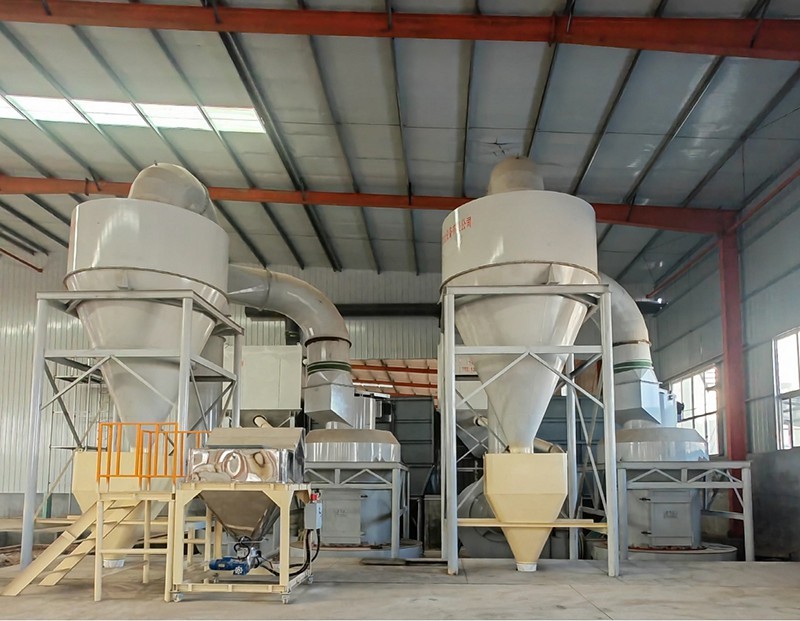
Install auxiliary equipment such as classifier,blower,jaw crusher,elevator,cyclone collector and dust collector in sequence according to the drawings.During classifier installation,ensure it is coaxial with the main engine spindle,and the rotor rotates flexibly without jamming.The blower shall be fixed horizontally,and pipelines shall be connected with tight sealing to prevent air leakage.For elevator installation,adjust the chain tightness to ensure stable operation without deviation.Cyclone collector and dust collector shall be installed with well-sealed interfaces to avoid dust leakage.
Step 5:Pipeline and Electrical Installation
Pipeline installation shall be carried out in strict accordance with the general layout;the position and height of pipelines shall not be changed arbitrarily.Sealing gaskets shall be installed at the flange connections of each pipeline,and bolts shall be tightened step by step in a diagonal order to ensure no air or powder leakage.Poor air duct sealing will seriously affect the system negative pressure and milling output.Electrical installation shall comply with the electrical schematic diagram with standardized wiring,especially the sensor circuits of the automatic electric control system,which shall be shielded to prevent interference.The grounding resistance of the control cabinet shall be less than 4 ohms,with clear wiring markings to avoid wiring errors.After installation,inspect the insulation performance of electrical equipment to ensure electricity safety.
 III.Commissioning and Acceptance:Step-by-Step Progress to Ensure Compliance
After equipment installation,comprehensive commissioning shall be carried out to ensure all equipment performance meets standards before formal operation.Commissioning is divided into two stages:no-load test run and load test run,to troubleshoot hidden risks step by step.
Before the no-load test run,fasten the grinding roller device with steel wire ropes to prevent contact impact between grinding rollers and grinding rings.Check whether all component bolts are tightened,whether lubricating oil is sufficiently filled,and whether electrical circuits are normal.First,start the blower independently and run it without load for a period of time,observing whether it operates smoothly without abnormal noise and vibration.The maximum temperature of rolling bearings shall not exceed 70℃,with a temperature rise of no more than 35℃.Then start the main engine and run it without load for no less than 1 hour,observing whether the main engine operates smoothly.The oil temperature in the box shall not exceed 80℃,with a temperature rise of no more than 40℃.Auxiliary equipment such as classifier and elevator shall operate synchronously without jamming or abnormal noise.
After the no-load test run passes,enter the load test run stage.The load test run shall last no less than 8 hours with gradual feeding,starting from 30%of the rated output,and increasing to 100%after stable operation.During the test run,closely monitor parameters such as main engine current,air pressure and powder fineness,inspect whether air or powder leakage occurs at pipeline connections,whether equipment vibration and noise are normal,and whether bearing temperature is within a reasonable range.After the test run,shut down the equipment to inspect whether fasteners are loose,tighten loose parts,clean residual materials inside the equipment,and complete commissioning and acceptance after confirming no abnormalities.
IV.Installation Precautions and Later Maintenance
Attention shall be paid to the following details during installation:when hoisting equipment,protective sleeves shall be installed at the contact parts between steel wire ropes and equipment to avoid collision damage;installation accuracy shall be strictly controlled,especially the horizontality of the main engine and coaxiality of couplings,which directly affect equipment operation stability;pipeline sealing shall be in place to avoid dust leakage and air volume loss;electrical wiring shall be standardized with earthing protection to prevent electric shock accidents.
After equipment installation and commissioning,a complete maintenance system shall be established to conduct regular inspection,lubrication and cleaning of the equipment.Vulnerable parts such as grinding rollers and grinding rings shall be inspected and replaced regularly.Lubricating oil shall be added to bearings as required:grinding roller bearings shall be refueled once per shift,main engine central bearings once every 4 shifts,and blower bearings once a month.Regularly clean accumulated powder in pipelines,inspect electrical circuits,and troubleshoot hidden risks in a timely manner to ensure long-term,efficient and stable operation of the equipment.
In summary,the installation of the Raymond grinding mill is a systematic project.Every link from foundation preparation to commissioning and acceptance must be carried out rigorously,standardly and precisely.Only by strictly following the installation steps,controlling installation quality,and completing commissioning and later maintenance can the milling efficiency of the equipment be fully exerted,the service life of the equipment be prolonged,and production be safeguarded for enterprises.


